
Now Reading: The Truth Behind Apple Teleport: Viral Hoax vs. Real-World Tech
-
01
The Truth Behind Apple Teleport: Viral Hoax vs. Real-World Tech

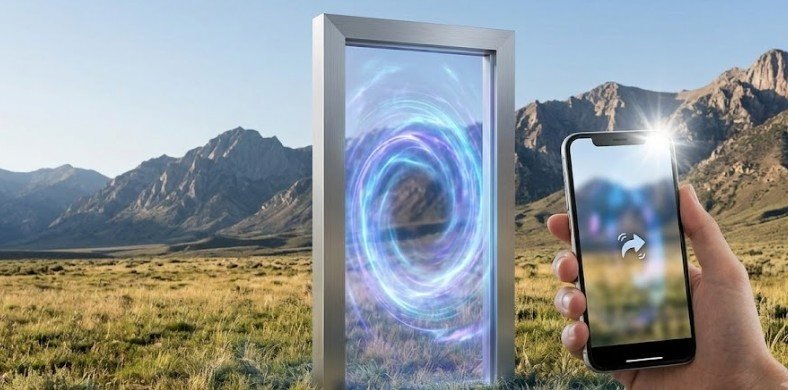
A viral video claiming that Apple secretly launched a $29 million instant movement device recently took over social media, leaving millions of viewers questioning reality. Promoted through hyper-realistic keynote edits and sleek 3D renders, the apple teleport trend became an overnight sensation across TikTok and X.
The short answer? It is an elaborate internet hoax. Apple has never designed, patented, or manufactured a physical teleportation machine.
Yet, the massive spread of this meme reveals something fascinating about how we perceive emerging technology. In an era dominated by AI-generated media, the line between actual product launches and digital satire has blurred. Understanding how these viral trends work—and how to separate science fiction from real tech—is essential for anyone trying to build digital literacy while managing their personal finances wisely.
Decoding the Apple Teleport Viral Trend
The phenomenon started when digital creators used generative video models and voice-cloning tools to construct a fake Apple Event. The convincing editing mimicked Apple’s minimalist design language, complete with smooth camera sweeps and executive presentations.
The hoax claimed that the tech giant had solved quantum displacement, offering instant travel for an astronomical price tag. While the concept is pure fiction, the viral reaction proved how easily convincing visual editing can mislead audiences.
Understanding media manipulation is similar to mastering personal finance: both require double-checking sources before investing your trust or money. The Federal Trade Commission (FTC.gov) regularly warns consumers about how online misinformation and deepfakes are increasingly used to drive impulse decisions and commercial scams.
The Real “Teleportation” Tools Inside the Apple Ecosystem
While physical matter transportation remains confined to theoretical physics, the word “teleport” pops up across real-world software in three very distinct ways.
1. Ecosystem Continuity and Handoff
Apple frequently uses spatial and seamless metaphors to describe its software features. Features like Handoff and AirPlay let you start a document on your iPhone and pick it up instantly on your Mac.
While users jokingly call this “teleporting” their workflow across screens, it actually relies on short-range Bluetooth LE discovery and peer-to-peer Wi-Fi connections managed by iCloud.
2. Video Editing Trickery
If you want to make yourself teleport on camera, you do not need millions of dollars. The Apple Education Community provides step-by-step guides showing students how to create a “jump-cut teleportation” effect using basic tools in iMovie.
By locking down a camera on a tripod, recording a subject walking away, and cutting the middle frames, creators produce the classic visual illusion of disappearing into thin air.
3. Open-Source Developer Utilities
If you search developer platforms like GitHub, you will find an open-source tool named Teleport. This third-party utility allows app developers to simulate custom GPS coordinates on iOS test devices. It helps programmers test location-based apps without physically traveling, but it has no official connection to Apple Inc.
| Feature Type | Claimed “Teleport” Function | Actual Underlying Technology |
| Viral Hoax | Instant physical travel for humans | Generative AI & video editing |
| Apple Handoff | Moving data seamlessly between devices | Bluetooth LE & iCloud sync |
| iMovie Jump-Cut | Visual disappearance in video projects | Frame editing & tripod locking |
| Developer Tools | Changing location metrics on software | Mock GPS location simulation |
Theoretical Physics vs. Digital Hoaxes
To understand why physical teleportation remains impossible today, it helps to look at real science. Physicists have achieved “quantum teleportation,” but that term does not mean moving physical objects.
According to research published by the Massachusetts Institute of Technology, quantum teleportation refers strictly to transferring subatomic quantum information between entangled particles across a distance. It involves moving data properties, not physical matter.
To physically transport a human body, a machine would need to record, dematerialize, transmit, and rebuild approximately $10^{28}$ atoms with perfect precision. The energy required to accomplish this exceeds current global power grids by vast orders of magnitude.
A 4-Step Checklist for Spotting Tech Scams and Viral Hoaxes
When headline-grabbing product claims flood your feed, run them through this quick diagnostic check before sharing them or spending your hard-earned dollars:
- Verify the Official Newsroom: Major announcements from public companies always appear directly on their official investor relations or press pages. If it is not on Apple’s Newsroom, it is not real.
- Examine the Audio Sync: AI voice clones often feature flat emotional cadences or slight audio drifting around hard consonant sounds.
- Check the Price Anchor: Scams and viral parodies often use absurdly high or oddly specific price tags (like $29 million) to provoke emotional reactions and commentary.
- Search Patent Databases: Legitimate tech breakthroughs leave a paper trail of public patent applications months or years before a product announcement.
Why Fake Tech Trends Matter to Budget-Conscious Consumers
Falling for online hoaxes might seem harmless, but hype culture frequently bleeds into real-world financial harm. Unscrupulous marketers often piggyback on viral tech trends to pitch fake pre-orders, shady crypto tokens, or fraudulent crowdfunding campaigns.
Building smart financial habits means practicing skepticism. Whether you are evaluating a viral tech claim or building your first monthly budget, evaluating claims objectively keeps your money safe. Instead of chasing fictional future tech, focusing your resources on high-yield savings, low-cost index funds, and practical digital tools delivers tangible long-term value.
Misconceptions About Apple’s Future Roadmap
It is easy to see why people fall for elaborate edits when tech advances so rapidly. However, separating fantasy from genuine engineering roadmaps helps set realistic expectations.
- Misconception: Spatial computing in devices like the Vision Pro is a step toward physical teleportation.
- Reality: Spatial computing creates immersive visual environments through high-resolution displays and real-time passthrough cameras. It alters perception, not location.
- Misconception: Tech companies hide game-changing physical discoveries from the public.
- Reality: Breakthrough technologies require immense supply chain coordination, regulatory approvals, and public testing long before commercial release.
Frequently Asked Questions
1. Is Apple Teleport a real product?
No, Apple Teleport is an internet hoax created using AI video tools, fake keynote edits, and CGI animation on platforms like TikTok.
2. Does Apple have a patent for teleportation?
No, Apple holds no patents related to physical teleportation or matter displacement. Their patents focus on consumer electronics, spatial computing, and software networks.
3. What is the open-source Apple Teleport tool on GitHub?
It is a third-party developer tool used to simulate custom GPS locations on iOS devices for software testing, completely unrelated to physical travel or Apple Inc.
4. How do I make a teleport effect on my iPhone?
You can create a teleportation jump-cut effect by recording video on a fixed tripod, pausing performance, stepping out of the frame, and editing out the middle transition using iMovie.
The viral sensation surrounding the fake apple teleport device highlights the impressive capabilities of modern editing tools and generative AI. While the idea of jumping across the globe at the push of a button remains pure sci-fi, real-world tech like Continuity, spatial audio, and cloud sync continue to bring our digital lives closer together. By sharpening your critical thinking skills and questioning viral hype, you protect both your digital awareness and your personal savings. Smart budgeting starts with seeing past the shiny illusions and focusing on what delivers genuine value in the real world.