Now Reading: Decoding the Blooket Bot: Cheating Scripts vs. The Bot Pack Collection
-
01
Decoding the Blooket Bot: Cheating Scripts vs. The Bot Pack Collection

Gamified learning has fundamentally transformed modern K–12 classrooms, turning routine quizzes into fast-paced digital competitions. Among these tools, Blooket stands out by blending multiple-choice questions with arcade-style mechanics, reward tokens, and collectible digital avatars called “Blooks.”
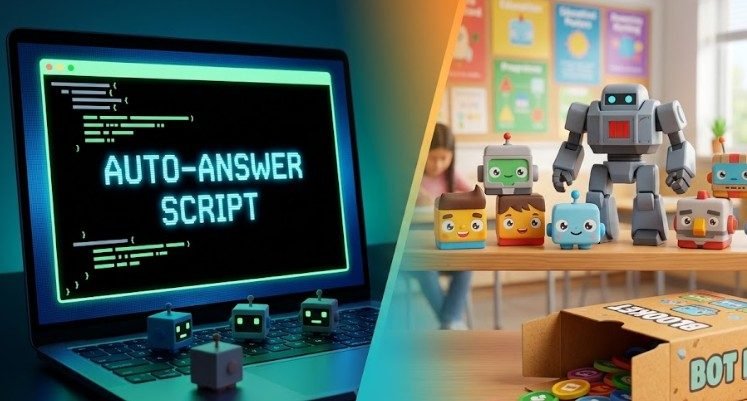
However, typing blooket bot into a search engine reveals a stark divide. On one hand, players encounter third-party automation scripts designed to manipulate gameplay or flood classroom lobbies. On the other, they discover the official “Bot Pack”—a robot-themed collection of in-game avatars unlocked through earned rewards. Understanding the difference between these two definitions is critical for students, educators, and parents looking to navigate the platform safely.
Game-Disrupting Scripts: How Blooket Hacks Work and Why They Fail
In the context of unofficial gameplay, a blooket bot typically refers to a user-created script or browser extension designed to alter game mechanics. Developed largely by independent programmers and shared on open platforms like GitHub, these automated programs usually fall into two main categories:
- Lobby Flood Bots: Automated programs that generate dozens of fake account instances to join a host’s game session simultaneously, effectively crashing or cluttering the teacher’s live scoreboard.
- Auto-Answer Scripts: Software injected into browser developer tools (or executed via bookmarklets) that scans the incoming HTML data, identifies the correct answer key, and submits the answer instantaneously to maximize token yield.
While these tools appeal to students seeking quick rewards or leaderboard status, they introduce significant technical and administrative risks. Modern EdTech platforms frequently update their application programming interfaces (APIs) and web security protocols to catch automated traffic.
Using unauthorized scripts creates several real-world issues:
- Account Penalties: Blooket actively monitors server activity for abnormal submission speeds. Systems that detect automated bot usage can flag the account, leading to temporary suspensions, total loss of accumulated tokens, or permanent bans under Blooket’s Terms of Service.
- Cybersecurity Risks: Downloading or running unverified JavaScript snippets from forums or third-party repositories creates severe security vulnerabilities. Malicious actors frequently obfuscate harmful code within “free cheat” scripts, exposing users to credential theft, browser hijacking, or malware installation.
- Educational Disruption: From an instructional perspective, spamming a classroom session prevents teachers from gathering accurate formative assessment data, defeating the primary goal of gamified learning.
The Official “Bot Pack”: Understanding In-Game Collectibles
Not every mention of a Blooket bot involves cheating. Within the platform’s legitimate ecosystem, the Bot Pack is a permanent set of robot-themed character avatars purchased in the Market using tokens earned through regular gameplay.
Each time a student completes a learning session, they earn tokens to “open” various themed packs, ranging from Medieval and Space to the popular Bot Pack. The items in this pack vary significantly in rarity, pull percentage, and resale value.
Note on Ultra-Rare Variants: Beyond the standard market rotation, Blooket occasionally hosts special events featuring “Mystical” Blooks. The Forgotten Bot, for instance, is an ultra-rare variant with an estimated drop rate near 1 in 25,000 during restricted event windows.
Evaluating Probability: The Math Behind the Drop Rates
A common misconception among beginner players is that buying a pack with a 0.3% drop rate 333 times guarantees a Legendary unlock. Mathematically, Blooket relies on independent Bernoulli trials—meaning every pack opened carries the exact same baseline probability regardless of prior attempts.
To calculate the statistical probability ($P$) of unlocking at least one Mega Bot (0.3% or 0.003 drop chance) across a set number of opened packs ($n$), you must calculate the inverse probability of failing every attempt:
$$P(\text{Unlock}) = 1 – (1 – 0.003)^n$$
For example, if a player saves enough tokens to open 100 Bot Packs:
$$P(\text{Unlock}) = 1 – (0.997)^{100} \approx 1 – 0.740 = 0.260 \text{ (or } 26\% \text{ chance)}$$
Even after opening 300 packs, the cumulative probability of landing the Mega Bot reaches roughly $59.4\%$, demonstrating why grinding tokens through regular gameplay requires a strategic, long-term approach rather than relying on short-term luck.
Cybersecurity in the Classroom: Protecting Digital Environments
The temptation to search for a blooket bot reflects a broader trend across digital education: the intersection of gaming incentives and online security. Federal guidelines managed by the Federal Trade Commission (FTC) under the Children’s Online Privacy Protection Act (COPPA) emphasize the necessity of keeping K–12 digital learning tools secure and transparent.
When students execute unauthorized scripts inside school networks, they potentially bypass local firewalls and expose institutional bandwidth to security threats. Educational organizations like CoSN (Consortium for School Networking) highlight that maintaining device security requires open communication between educators and students regarding the risks of running unverified web scripts.
Safe Token Grinding: A Checklist for Beginners
Rather than risking account security with unauthorized scripts, beginners can optimize their legitimate token collection using built-in game mechanics:
- Play Solo Tower Defense or Cafe Modes: These game modes allow players to work at their own pace, generating consistent end-of-game token payouts without requiring a live teacher-hosted session.
- Maximize the Daily Wheel Bonus: Log in daily to claim the multiplier bonus, which significantly boosts token earnings for the first few completed games.
- Sell Duplicate Uncommon Blooks: Open low-cost packs and immediately resell duplicate Uncommon or Rare characters back to the Market to regain tokens for higher-tier packs.
- Participate in Seasonal Events: Save saved tokens for limited-time event packs, which often feature boosted rates for rare variants.
Frequently Asked Questions
1. Can using a Blooket bot get my account banned?
Yes. Blooket’s anti-cheat detections flag accounts exhibiting automated inputs or abnormal submission speeds, which can lead to token resets, temporary suspensions, or permanent account bans.
2. How do I get the Mega Bot in Blooket legally?
The Mega Bot is legally obtained by purchasing the 20-token Bot Pack in the Market. It is a Legendary drop with a 0.3% probability per pack opened.
3. Are Blooket hack scripts on GitHub safe to download?
No. Unverified third-party scripts frequently contain malicious code, keyloggers, or hidden browser redirects that put your personal data and computer security at risk.
4. What is the rarest bot in Blooket?
The rarest bot avatar is the Forgotten Bot, an ultra-rare Mystical variant available only during specific limited-time events with an estimated drop rate around 1 in 25,000.
Understanding the difference between unauthorized cheat scripts and the official Bot Pack is essential for any player entering the Blooket ecosystem. While automated hacks promise short-lived leaderboards, they carry significant risks of account bans and malware exposure.
By focusing instead on strategic solo gameplay, managing token math, and participating in seasonal market events, players can build an impressive collectible library safely. Stick to legitimate strategies, protect your account credentials, and enjoy the thrill of the hunt every time you open a new pack!