Now Reading: The Tesla Pi Phone Myth: Why the Smartphone That Doesn’t Exist Won’t Die
-
01
The Tesla Pi Phone Myth: Why the Smartphone That Doesn’t Exist Won’t Die

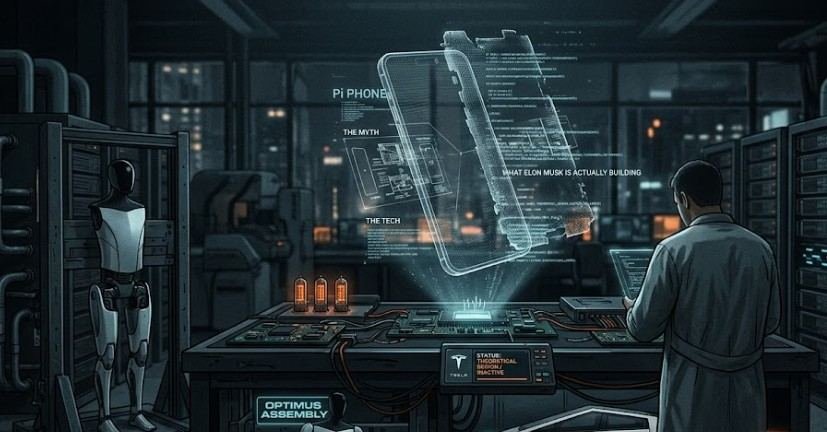
If you offer a smartphone buyer free satellite internet, zero electric bills via solar backplates, and a direct link to their EV, they will likely ask where to sign up.
That exact promise generated millions of YouTube views and thousands of frantic search queries for the tesla pi phone. Yet, the most surprising fact about this world-changing handheld is remarkably simple: it does not exist, and Tesla has no plans to build it.
In late 2024, during an appearance on The Joe Rogan Experience, Tesla CEO Elon Musk addressed the persistent rumors directly: “No, we’re not doing a phone”. He added that the company would only consider building one if tech giants like Apple and Google began heavily censoring apps or acting as hostile gatekeepers.
Despite explicit denials, the “Model Pi” continues to haunt social media feeds and online forums. Understanding why this internet myth persists reveals a lot about tech fandom, modern scam tactics, and the direction mobile hardware is actually taking.
Anatomy of an Internet Myth: How the Model Pi Was Born
The rumor mill did not invent the Tesla phone out of nowhere. Instead, digital creators stitched together genuine technological advancements from Musk’s various business ventures, wrapped them in polished 3D concept renders, and published them as “leaks.”
When hyper-realistic fan art meets clickbait video titles, algorithms quickly amplify the story. The speculative features usually center around four core capabilities:
1. Direct Starlink Connectivity
Concept art frequently depicts the Tesla phone bypassing traditional cellular towers to stream data directly from SpaceX’s satellite constellation. While SpaceX is actively deploying Direct-to-Cell technology, it relies on partnerships with existing terrestrial carriers like T-Mobile, rather than custom proprietary handhelds.
2. Solar-Assisted Trickle Charging
Fans theorized that Tesla’s photo-voltaic engineering could translate into a solar panel embedded under the phone’s rear glass. In engineering reality, a surface area as small as a smartphone backplate absorbs barely enough ambient sunlight to generate a fraction of a milliwatt—far too little to offset modern processor power draw.
3. Deep Tesla Vehicle Integration
Rumors suggested the device would serve as an unhackable key, remote control dashboard, and media center for Tesla EVs. While intriguing, the existing Tesla app on iOS and Android already performs almost all of these functions via Bluetooth Low Energy (BLE) and cellular API links.
4. Neuralink Brain-Computer Interfaces
The most sci-fi claim involved controlling the device using thought alone via Neuralink implants. Though Neuralink continues human clinical trials, its medical-grade implants are designed for paralyzed patients to restore autonomy, not for scrolling social media hands-free.
The Dark Side of the Hype: Scams and Phishing
Unfounded product hype often brings consumer risk. Search traffic for the tesla pi phone has created an industry of deceptive websites attempting to capitalize on enthusiastic buyers.
Consumer Warning: Tesla does not accept deposits, reservations, or waitlist sign-ups for any mobile device. Any third-party site requesting money or personal information for a “Model Pi Pre-Order” is fraudulent.
Scammers typically deploy three tactics:
- Fake Pre-Orders: Sites requiring cryptocurrency or credit card down payments to “reserve” early production units.
- Phishing Forms: Landing pages harvesting full names, home addresses, and financial data under the guise of an “exclusive tester waitlist.”
- Malware Downloads: Videos pointing users to third-party APKs or software tools claiming to feature the “Tesla OS interface.”
Evaluating the Ecosystem: Myth vs. Reality
To understand why a dedicated hardware device makes little sense for Tesla right now, it helps to weigh the rumored capabilities against existing market solutions:
| Feature | The Rumored “Model Pi” | What You Can Actually Buy Today |
| Global Satellite Data | Proprietary built-in Starlink chip | Apple Emergency SOS via Satellite; carrier-backed Direct-to-Cell LTE |
| Vehicle Integration | Native hardware-level EV control | Official Tesla App on iOS & Android (Keyless entry, climate control, Summon) |
| Power Management | Integrated solar backplate | High-efficiency external power banks; MagSafe/Qi wireless chargers |
| Operating System | Custom “Tesla OS” concept | iOS and Android (supported by millions of app developers) |
| Market Status | Pure Fiction | Available Commercial Hardware |
Developing a smartphone from scratch requires billions in capital, complex supply chain logistics, and millions of software developers to build an app ecosystem. Tesla’s core focus remains centered on scaling electric vehicles, utility-scale energy storage, and autonomous robotics.
The Real Future: How Actual Cell Networks Are Evolving
While the Model Pi is fictional, the underlying technology that inspired it is real. Satellite-to-phone connectivity is rapidly transforming from a gimmick into a standard consumer safety feature.
Regulators like the Federal Communications Commission (FCC) have established legal frameworks like Supplemental Coverage from Space (SCS). This framework permits satellite operators to collaborate with mobile carriers using existing terrestrial spectrum, helping eliminate remote dead zones without requiring consumers to purchase specialized hardware.
Similarly, organizations such as the Institute of Electrical and Electronics Engineers (IEEE) publish technical standards that allow existing smartphones to maintain low-bandwidth connections with orbiting low-Earth orbit (LEO) satellites. The technological future envisioned by Tesla phone rumors is arriving—it is just being delivered through the device already in your pocket.
Frequently Asked Questions
1. Is the Tesla Pi Phone officially confirmed by Elon Musk?
No. Elon Musk has explicitly denied plans to launch a Tesla phone, stating the company would only consider it if Apple and Google began enforcing severe app store censorship.
2. How much will the Tesla phone cost if released?
The phone does not exist, so there is no official price. Internet claims alleging prices like $299 or $789 are completely fabricated by clickbait channels.
3. Can I pre-order the Tesla Model Pi online?
No. Any platform, website, or social media link claiming to accept pre-orders or waitlist deposits for a Tesla phone is an unauthorized scam.
4. Does Starlink work with normal smartphones?
Yes. SpaceX is currently partnering with traditional wireless carriers to provide satellite coverage directly to unmodified modern 4G and 5G smartphones.
Separating Speculation from Reality
The obsession over the tesla pi phone demonstrates how deeply consumers desire real hardware innovation. However, chasing phantom devices often leads to misinformation or online scams. Tesla’s engineering ambitions remain focused on autonomous transit, artificial intelligence, and clean energy grid infrastructure rather than consumer electronics.
Fortunately, features like satellite messaging and seamless vehicle control are already becoming standard across mainstream smartphones. Instead of waiting for a mythical handset, consumers can safely enjoy these expanding capabilities on existing iOS and Android platforms today.