
Now Reading: Quantum Breakthroughs: Inside the 2024 Shifts in Processing Power and Stability
-
01
Quantum Breakthroughs: Inside the 2024 Shifts in Processing Power and Stability

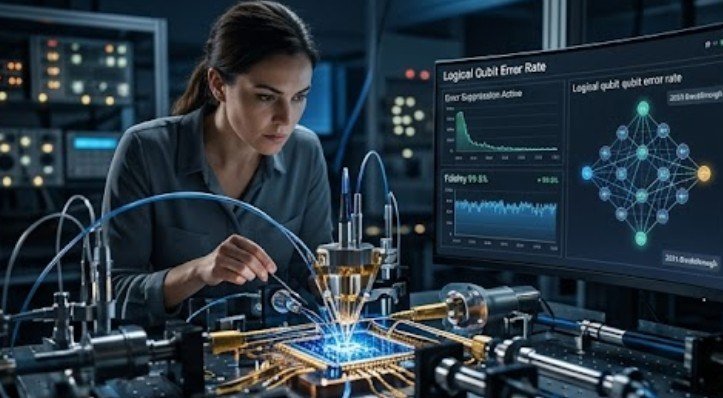
A quantum computer ran an algorithm in 2024 that would take the world’s fastest classical supercomputer 10,000 years to solve, completing it in under three minutes. That single experiment proved that quantum computing advancements and discoveries in 2024 have officially moved this field from theoretical physics into real-world engineering.
For years, critics argued that physical noise and fragile hardware would keep quantum systems stuck inside academic laboratories indefinitely. The breakthroughs over the past year shattered those doubts. Engineers moved past simply adding raw qubits to building fault-tolerant architectures capable of self-correcting errors in real time.
Understanding these advancements reveals how quantum computing works, why tech giants are spending billions on it, and what these changes mean for cybersecurity and industry.
The Big Pivot: From Raw Qubit Counts to Reliable Architecture
In previous years, quantum computing press releases focused purely on qubit totals—the fundamental units of quantum information equivalent to classical bits (0s and 1s). However, physical qubits are extremely fragile. Environmental heat, electromagnetic radiation, and minute vibrations cause “decoherence,” causing the system to lose data and produce errors.
The primary story of 2024 was the industry-wide focus on fault tolerance and error correction. Instead of building larger, unstable systems, research teams grouped multiple physical qubits together into single “logical qubits” that protect data.
When researchers at the National Institute of Standards and Technology (NIST) evaluated hardware stability, they emphasized that logical qubit fidelity is the true metric for practical quantum supremacy.
Major Hardware Milestones and Discoveries in 2024
Several industry pioneers and research labs published historic hardware milestones in 2024 that altered the trajectory of quantum development.
Google’s Willow Quantum Chip
Google unveiled its Willow quantum processor, built with 105 superconducting qubits. Previous generations suffered higher total noise as more qubits were added. Willow demonstrated for the first time that scaling up the physical qubit count decreased system noise below the threshold required for continuous error suppression.
Microsoft and Quantinuum’s Logical Qubit Entanglement
Microsoft teamed up with Quantinuum to entangle 12 reliable logical qubits. By applying active error-correcting algorithms to ion-trap hardware, the team executed complex operations with error rates hundreds of times lower than raw physical systems.
Cat Qubits and Neutral-Atom Platforms
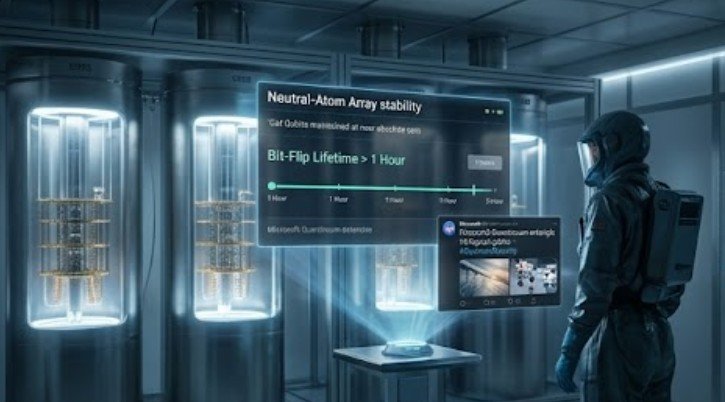
Startups like Alice & Bob advanced “cat qubits”—a specialized architecture engineered to resist bit-flip errors naturally. Meanwhile, neutral-atom quantum processors achieved bit-flip lifetimes exceeding an hour, proving that alternate hardware types can perform without massive cooling infrastructure.
Performance Enhancements and Practical Industry Adoption
Raw hardware stability directly translates into real-world computational speed. IBM’s Quantum Heron processor delivered efficiency gains up to 50 times faster than its predecessor, allowing complex chemical and logistical simulations to run in hours rather than weeks.
This performance boost led major financial institutions and global logistics companies to initiate live commercial trials. Banks used quantum algorithms to model portfolio risks during extreme market volatility, while shipping firms optimized complex global supply chains with thousands of daily variables.
Research published by the U.S. National Science Foundation (NSF) highlighted that these hybrid workflows—where classical supercomputers offload complex sub-routines to quantum processors—represent the standard model for near-term business adoption.
Comparing 2024 Quantum Milestones
To see how far the technology has progressed, compare the operational shifts between legacy quantum systems and the architecture established in 2024:
| Feature | Legacy Quantum Architecture | 2024 Quantum Architecture |
| Primary Metric | Raw Physical Qubit Count | Fault-Tolerant Logical Qubits |
| Error Handling | Uncorrected / High Error Drift | Active Quantum Error Correction (QEC) |
| Coherence Time | Microseconds | Hours (via Cat/Neutral-Atom Qubits) |
| System Speed | Baseline Benchmarks | Up to 50x Processing Gains (e.g., Heron) |
| Primary Use | Academic Physics Testing | Hybrid Commercial Pilots (Finance/Logistics) |
Why Quantum Computing Matters in Real Life
Quantum computers will not replace desktop PCs or smartphones. Instead, they operate as specialized accelerators for computational problems that would choke classical supercomputers.
- Medicine and Drug Discovery: Simulating a single complex protein molecule requires analyzing trillions of subatomic interactions. Quantum processors simulate molecular structures natively, reducing early-stage pharmaceutical discovery from years to days.
- Next-Gen Batteries: Designing high-density solid-state batteries requires atomic-scale materials science. Quantum simulations reveal chemical bonding behaviors that traditional algorithms miss.
- Supply Chain Optimization: Finding the absolute best route for thousands of global cargo ships involves more combinations than there are atoms in the universe. Quantum optimization algorithms process these variables simultaneously.
Is Your Organization Ready? A Post-Quantum Action Plan
Because quantum computers excel at solving complex math, they threaten current encryption standards like RSA and ECC. Security experts urge organizations to take defensive steps today using this four-step readiness framework:

- Inventory Sensitive Data: Identify where high-value, long-term encrypted data resides across network infrastructure.
- Audit Cryptographic Assets: Locate every legacy encryption algorithm embedded within software systems, databases, and network hardware.
- Transition to Post-Quantum Cryptography (PQC): Begin migrating digital signatures and key exchanges to NIST-approved post-quantum encryption standards.
- Deploy Crypto-Agile Tools: Upgrade software pipelines so encryption methods can be swapped out without breaking underlying platforms.
Organizations seeking specialized platforms to organize digital workflows and monitor system migrations can evaluate software solutions like the best account management software to streamline administrative oversight.
Limitations, Misconceptions, and Realities
Despite these leaps, several key misconceptions persist about quantum systems:

- Myth: Quantum computers replace classical computers.
- Fact: Quantum processors act as co-processors for specialized math; classical chips still run everyday operating systems and display interfaces.
- Myth: Quantum systems think faster.
- Fact: They do not run traditional code faster; they use quantum superposition and entanglement to eliminate dead-end search paths instantly.
- Limitation: Extreme Operating Conditions. Superconducting qubits require dilution refrigerators cooled near absolute zero (0Kelvin or -459F), making data center integration expensive and complex.
Frequently Asked Questions
1. What was the most important quantum discovery of 2024?
The shift to fault-tolerant logical qubits. Demonstrating that adding physical qubits reduces noise below the error-correction threshold proved that commercial, large-scale quantum computers are engineeringly feasible.
2. Will quantum computing break all internet encryption soon?
Not immediately. While quantum algorithms can theoretically crack traditional RSA encryption, fault-tolerant machines large enough to execute these attacks are still several years away. NIST has already finalized post-quantum standards.
3. How are quantum computers different from supercomputers?
Supercomputers process information sequentially using binary bits (0 or 1). Quantum computers use qubits that exist in superposition (0, 1, or both simultaneously), calculating millions of possibilities at once.
4. Can businesses buy a quantum computer today?
Most organizations access quantum processing power through cloud API subscriptions provided by companies like IBM, Google, and Amazon, rather than purchasing physical hardware.
The quantum computing advancements and discoveries in 2024 proved that this transformative technology is no longer stuck in theoretical limbo. By overcoming error correction barriers, hardware engineers opened the door to real-world applications in medicine, logistics, and material science. As quantum availability expands through cloud platforms, organizations that start preparing their systems today will lead the market tomorrow. The era of quantum utility is officially here—the only question left is how quickly industries will adapt.